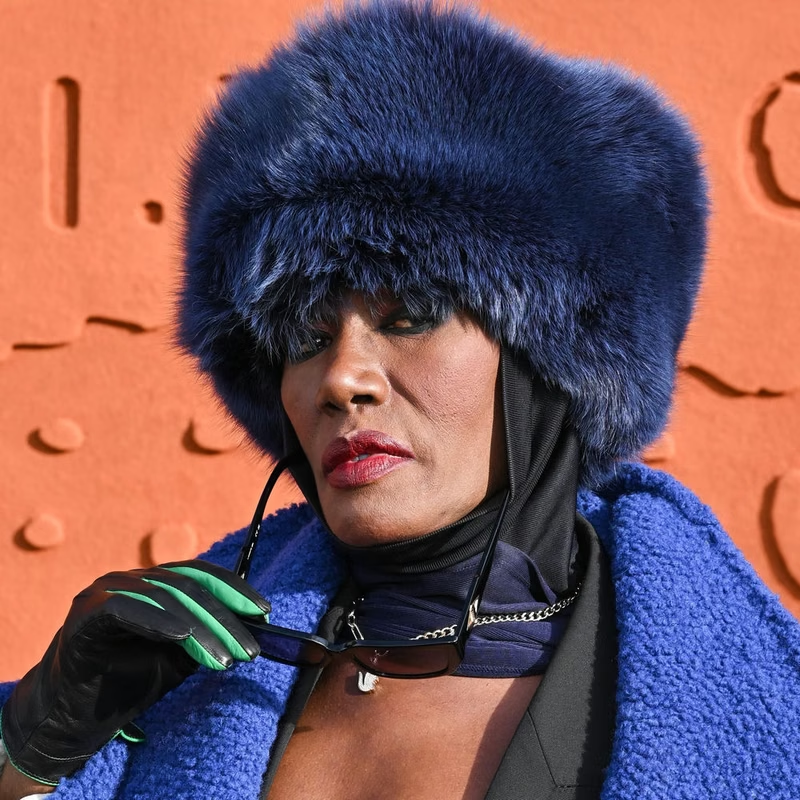
Grace Jones
She walked onto the set of a photo shoot in the 1970s and decided that the camera was not going to tell her what to do. Grace Jones was born in Jamaica, raised in Syracuse, and discovered as a model in New York, but the fashion industry could not hold her. She was too tall, too angular, too Black, too androgynous. The industry did not know what to do with a woman who looked like she could break the lens just by staring through it. So she took her body to Paris, where the avant-garde embraced her, and she became the face of Yves Saint Laurent and Kenzo before deciding that fashion was not enough.

The cost of that decision was leaving a lucrative career for one that paid nothing upfront. Jones moved into music with a sound that nobody had heard before. Her early disco albums sold modestly, but it was not until she connected with producer Sly Dunbar and the Compass Point All-Stars in the Bahamas that she found her voice. The albums Warm Leatherette, Nightclubbing, and Living My Life -- recorded between 1980 and 1982 -- created a sound that was part reggae, part new wave, part funk, and entirely unsettling in the best way. The rhythm section of Sly and Robbie locked into grooves that felt mechanical and human at the same time. Jones's vocal came in somewhere between a chant and a command.

Pull Up to the Bumper is the one. That bassline, the deadpan vocal, the double-entendre that was so obvious it wrapped around to art -- the song became an underground classic and then a mainstream hit. She followed it with Private Life and Walking in the Rain, each track starker than the last. Jean-Paul Goude, her partner and director, created the visual language that matched the music: the geometric silhouettes, the angular poses, the body painted and boxed and made into sculpture.

The 1986 film Vamp put her on screen. The James Bond theme for A View to a Kill proved she could work inside the machine without being flattened by it.

Grace Jones is still operating at seventy-six, still performing in the same leather jackets and angular cuts, still refusing to be comfortable. She did not build a career. She built an icon, and the icon has outlived every category the industry tried to put her in. The fashion world could not frame her. The music industry could not genre her. The film industry could not typecast her. She is not a singer who models or a model who acts. She is Grace Jones, and the only category that holds her is the one she invented for herself.

Grace Jones was profiled in the documentary, Grace Jones: Bloodlight and Bami, in 2017.

Image Credits

1,414 artist portraits across 5 genres (Rock, Jazz, Soul, Blues, Folk). 1,363 sourced from Wikipedia (Creative Commons / Public Domain), 50 from Deezer (promotional artwork).

Full attribution breakdown →

Grace Jones

She walked onto the set of a photo shoot in the 1970s and decided that the camera was not going to tell her what to do. Grace Jones was born in Jamaica, raised in Syracuse, and discovered as a model in New York, but the fashion industry could not hold her. She was too tall, too angular, too Black, too androgynous. The industry did not know what to do with a woman who looked like she could break the lens just by staring through it. So she took her body to Paris, where the avant-garde embraced her, and she became the face of Yves Saint Laurent and Kenzo before deciding that fashion was not enough.

The cost of that decision was leaving a lucrative career for one that paid nothing upfront. Jones moved into music with a sound that nobody had heard before. Her early disco albums sold modestly, but it was not until she connected with producer Sly Dunbar and the Compass Point All-Stars in the Bahamas that she found her voice. The albums Warm Leatherette, Nightclubbing, and Living My Life -- recorded between 1980 and 1982 -- created a sound that was part reggae, part new wave, part funk, and entirely unsettling in the best way. The rhythm section of Sly and Robbie locked into grooves that felt mechanical and human at the same time. Jones's vocal came in somewhere between a chant and a command.

Pull Up to the Bumper is the one. That bassline, the deadpan vocal, the double-entendre that was so obvious it wrapped around to art -- the song became an underground classic and then a mainstream hit. She followed it with Private Life and Walking in the Rain, each track starker than the last. Jean-Paul Goude, her partner and director, created the visual language that matched the music: the geometric silhouettes, the angular poses, the body painted and boxed and made into sculpture.

The 1986 film Vamp put her on screen. The James Bond theme for A View to a Kill proved she could work inside the machine without being flattened by it.

Grace Jones is still operating at seventy-six, still performing in the same leather jackets and angular cuts, still refusing to be comfortable. She did not build a career. She built an icon, and the icon has outlived every category the industry tried to put her in. The fashion world could not frame her. The music industry could not genre her. The film industry could not typecast her. She is not a singer who models or a model who acts. She is Grace Jones, and the only category that holds her is the one she invented for herself.

Grace Jones was profiled in the documentary, Grace Jones: Bloodlight and Bami, in 2017.

The Sunday Drop
One song. One story. Every Sunday.

No algorithms. No trending sections. Just a song someone loved and the story behind it. Delivered Sunday morning.

Free. No spam. Unsubscribe anytime.

Image Credits

1,414 artist portraits across 5 genres (Rock, Jazz, Soul, Blues, Folk). 1,363 sourced from Wikipedia (Creative Commons / Public Domain), 50 from Deezer (promotional artwork).

Full attribution breakdown →

0:00
0:00
The Sunday Drop One song. One story. Every Sunday.